

If you’re working in Canada — or planning to start — the federal minimum wage Canada 2026 update could directly affect your income.
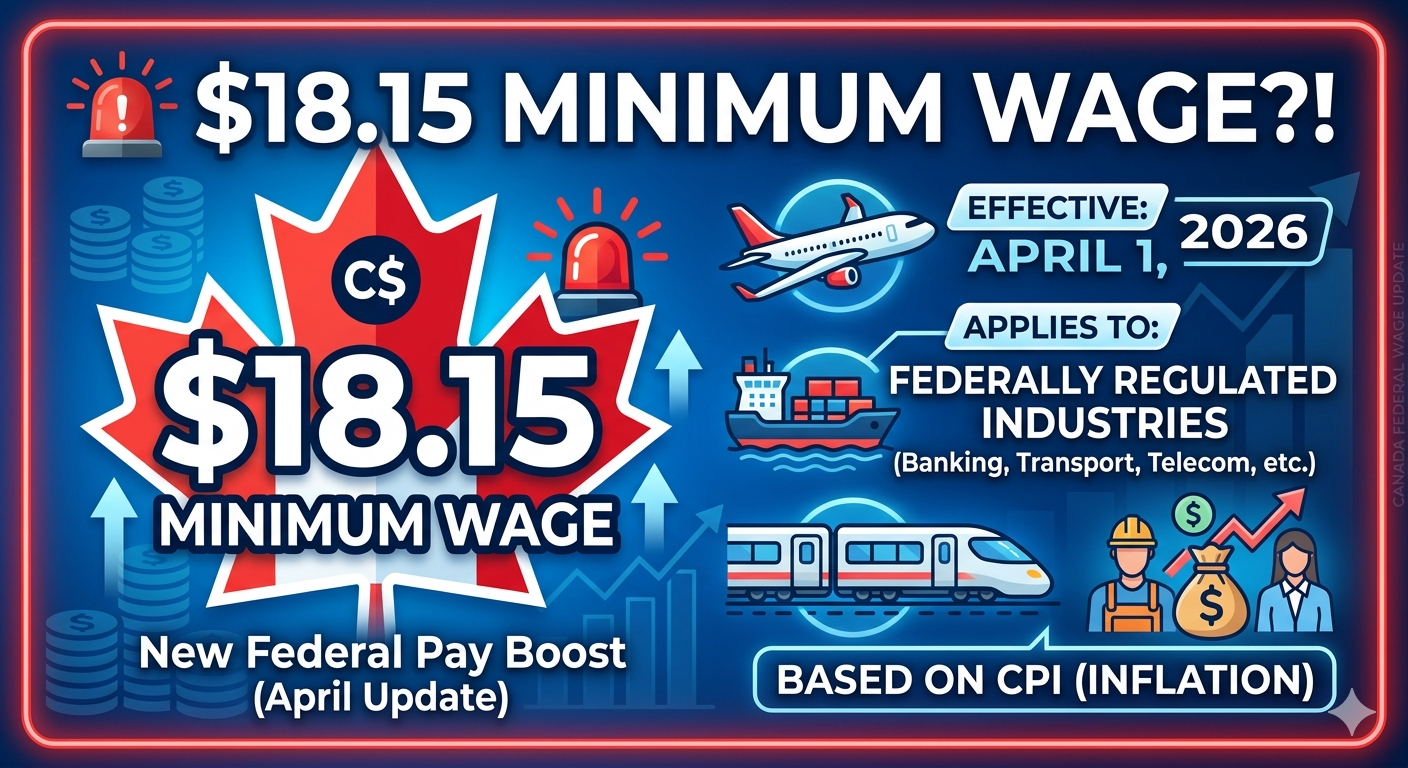
Starting April, the federal minimum wage will increase to $18.15 per hour, and this change is more important than it looks.
However, many newcomers misunderstand how the federal minimum wage Canada system actually works. So let’s break it down in a simple, beginner-friendly way.
📌 What is the Federal Minimum Wage Canada 2026 Update?
The federal minimum wage Canada 2026 is increasing:
- New wage: $18.15/hour
- Increase: +$0.40
- Effective date: April 1 (annual adjustment)
This wage applies to workers regulated by
👉 Government of Canada
through
👉 Employment and Social Development Canada
In addition, the federal minimum wage Canada is adjusted every year based on inflation (CPI).
❗Who is Eligible for the Federal Minimum Wage Canada?
Here’s the most important part.
The federal minimum wage Canada does NOT apply to all workers.
It only applies to federally regulated industries, such as:
- Banking
- Airlines and airports
- Telecommunications
- Interprovincial transportation
👉 Therefore, most people working in restaurants, retail, or warehouses are NOT covered by the federal minimum wage Canada.
🏙️ Ontario Minimum Wage vs Federal Minimum Wage Canada
If you live in
👉 Ontario
you must understand this clearly:
- Ontario has its own minimum wage system
- It is updated every October
- It is separate from the federal minimum wage Canada
👉 This means the federal minimum wage Canada 2026 increase in April does not automatically apply to Ontario workers.
🔗 Helpful Internal Guides (Start Here)
To improve your understanding, check these related guides:
- 👉 How to check your job type in Canada (Federal vs Provincial)
- 👉 Ontario minimum wage update guide 2026
- 👉 Salary negotiation tips for newcomers in Canada
- 👉 How to avoid underpayment as a new immigrant
👉 These internal links help you build a full strategy around the federal minimum wage Canada 2026.
💡 Why Federal Minimum Wage Canada 2026 Still Matters to You
Even if you are not directly affected, the federal minimum wage Canada increase still impacts you.
1. Market Wage Pressure
When the federal minimum wage Canada increases:
- Employers adjust wages
- Entry-level pay rises
- Competition increases
👉 As a result, your earning potential improves.
2. Best Time to Change Jobs
The best time to switch jobs is:
👉 April to June
Because:
- Companies adjust salary budgets
- The federal minimum wage Canada sets a new baseline
3. Newcomer Advantage
If you are new to Canada:
- You can avoid being underpaid
- You can reference the federal minimum wage Canada in interviews
- You gain negotiation confidence
🧭 Step-by-Step: How to Use Federal Minimum Wage Canada 2026
Follow this simple plan:
✅ Step 1: Check If Your Job Is Federal
Use the official page:
👉 https://www.canada.ca/en/services/jobs/workplace/federal-labour-standards.html
✅ Step 2: Compare Your Wage
Ask:
- Am I earning near minimum wage?
- Is my pay below the federal minimum wage Canada benchmark?
✅ Step 3: Use It in Negotiation
Example:
“I saw the federal minimum wage Canada 2026 increased to $18.15.
I’d like to review my current compensation.”
👉 Simple, but effective.
✅ Step 4: Track Ontario Minimum Wage
Check updates here:
👉 https://www.ontario.ca/document/your-guide-employment-standards-act-0/minimum-wage
⚠️ Common Mistakes About Federal Minimum Wage Canada
❌ Thinking it applies to all jobs
❌ Ignoring provincial rules
❌ Not updating salary expectations
❌ Missing negotiation timing
🔥 Pro Strategy Using Federal Minimum Wage Canada
Here’s what most people don’t do:
👉 Use the federal minimum wage Canada 2026 news as leverage
Even if your employer doesn’t raise your wage:
- You can ask
- You can negotiate
- You can switch jobs
👉 If you don’t act, you lose money
Even better? If you’re new to Canada, you can actually use this change to improve your income strategy immediately.
Let’s break it down clearly, step by step — no complicated terms.
🇨🇦 What’s Actually Changing?
The federal minimum wage (for workers in federally regulated industries) is increasing:
- New Wage: $18.15/hour
- Increase: +$0.40
- Effective Date: April (annual adjustment based on inflation)
This adjustment is managed by
👉 Government of Canada
through
👉 Employment and Social Development Canada
✔️ It is tied to inflation using the Consumer Price Index (CPI).
✔️ It is updated every year (April 1).
❗ IMPORTANT: Does This Apply to You?
Here’s where many newcomers get confused.
👉 Federal minimum wage ONLY applies to specific sectors, such as:
- Banks
- Airports & airlines
- Telecommunications
- Interprovincial transportation
If you work in a regular job (restaurant, retail, warehouse), your wage follows provincial rules, not federal.
🏙️ What About Ontario?
For example:
👉 Ontario
- Minimum wage is adjusted separately
- Usually updated every October
So even if the federal wage increases in April,
👉 Ontario workers will see changes later in the year.
💡 Why This Matters (Even If You’re Not Federal Worker)
Here’s the hidden opportunity 👇
1. Wage Pressure Effect
When federal wages go up, companies often:
- Increase wages to stay competitive
- Adjust entry-level pay
👉 That means your salary negotiation power increases
2. Job Switching Timing Strategy
Best time to change jobs?
👉 April ~ June
Because:
- Companies adjust budgets
- New wage benchmarks kick in
3. Immigration Advantage
If you’re new in Canada:
- Knowing wage standards = avoid underpayment
- Helps during interviews (“market rate awareness”)
🧭 Step-by-Step: How Beginners Can Use This
Even if you just arrived, follow this:
✅ Step 1: Check Your Industry
Use this official site
https://www.canada.ca/en/services/jobs/workplace/federal-labour-standards.html
✔️ See if your job is federally regulated
✅ Step 2: Compare Your Wage
Ask yourself:
- Am I earning near minimum wage?
- Am I underpaid compared to new standards?
✅ Step 3: Use It in Negotiation
Example:
“I understand the federal minimum wage increased to $18.15.
Based on market adjustments, I’d like to discuss my compensation.”
👉 Simple but powerful.
✅ Step 4: Track Provincial Updates
Check here regularly:
👉 https://www.ontario.ca/document/your-guide-employment-standards-act-0/minimum-wage
✔️ Especially if you live in Ontario
✔️ Updates usually happen in October
⚠️ Common Mistakes Newcomers Make
❌ Thinking all jobs follow federal wage
❌ Not checking province-specific rules
❌ Accepting outdated pay
❌ Not renegotiating after wage increase
🔥 Pro Tip (This Is What Most People Miss)
Even if your wage doesn’t automatically increase:
👉 Use the news as leverage
Employers expect employees to ask.
If you don’t?
You’re leaving money on the table