
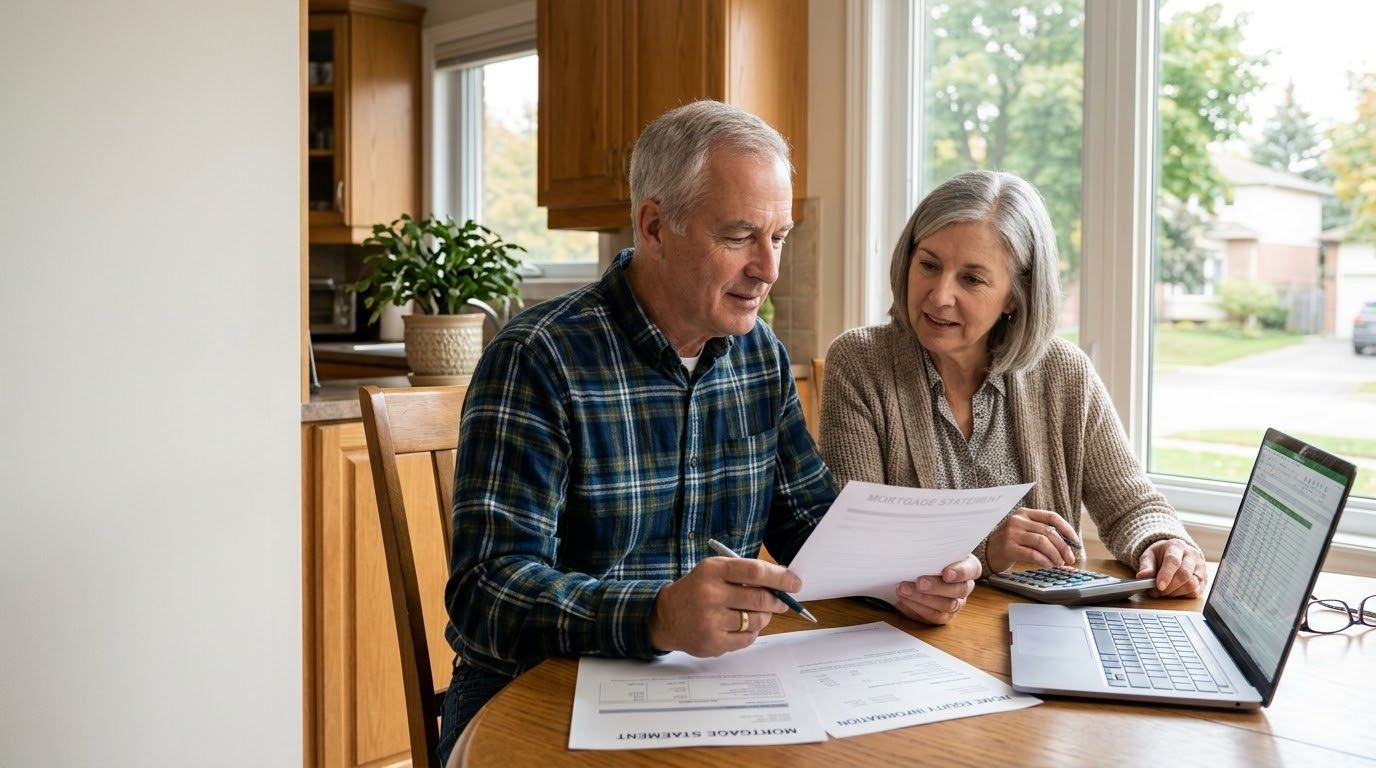

AI-generated reference image created to help illustrate the article.
By Caduck | August 20, 2026
Editorial Note: Caduck prepared this article after reviewing current information from the Financial Consumer Agency of Canada and British Columbia legislation. This article provides general information and does not replace professional financial, tax or legal advice.
Many Canadian retirees face an unusual financial problem.
They may own a valuable home but have relatively little monthly cash.
Selling and downsizing can release that equity, but not everyone wants to leave the neighbourhood, home or community where they have spent decades.
A reverse mortgage offers another option.
It allows eligible homeowners, usually age 55 or older, to borrow against part of their home equity without immediately selling the property.
According to the Financial Consumer Agency of Canada (FCAC), homeowners can usually borrow up to 55% of their home’s current value. They generally don’t make regular loan payments while the reverse mortgage remains in place.
That combination sounds attractive for a retiree trying to cover living costs.
But there is another side to the calculation.
Interest accumulates over time. Reverse mortgage rates also tend to run higher than conventional mortgages or home equity lines of credit (HELOCs). As the balance grows, the equity left in the home can shrink.
That can eventually affect how much money remains for an estate and its beneficiaries.
The key point:
A reverse mortgage can turn part of your home equity into cash without forcing you to sell your home. But you are borrowing that money, not withdrawing free retirement income. Interest increases the balance over time and can reduce the equity that remains in your estate.
What Exactly Is a Reverse Mortgage?
A reverse mortgage lets a homeowner borrow against the equity already built up in a home.
FCAC says applicants usually need to be at least 55 years old.
The property also usually needs to serve as the borrower’s primary residence, which generally means the homeowner lives there for at least six months of the year.
The lender determines how much someone can borrow based on several factors, including the homeowner’s age, the ages of other people registered on title, the property’s condition and its appraised value.
The maximum commonly reaches 55% of the home’s current value.
That doesn’t mean every 55-year-old homeowner automatically receives 55%.
The lender calculates the actual amount after reviewing the property and borrowers.
How Much Could a Homeowner Access?
Consider a simple example.
If a home has an appraised value of $1 million, 55% equals $550,000.
That does not guarantee a $550,000 reverse mortgage. The lender still applies its eligibility rules and considers existing debt secured against the property.
But the calculation shows why the product attracts attention in expensive Canadian housing markets.
A retiree may have accumulated substantial wealth through a home while receiving much less money each month from pensions and retirement savings.
A reverse mortgage converts part of that housing wealth into accessible cash without requiring an immediate sale.
Do You Have to Make Monthly Mortgage Payments?
Normally, no.
FCAC says borrowers do not need to make regular payments on a reverse mortgage.
That distinguishes it from a traditional mortgage or HELOC and explains why some retirees consider it for cash-flow purposes.
Instead of sending a required principal-and-interest payment every month, the borrower allows interest to accumulate on the outstanding balance.
The lender may also allow voluntary payments, subject to the mortgage agreement.
The absence of required monthly payments can free up cash for groceries, property taxes, home maintenance, healthcare expenses or other retirement costs.
But removing the monthly payment does not remove the borrowing cost.
The debt continues growing as interest accumulates.
Is Reverse Mortgage Money Taxable in Canada?
FCAC describes money received through a reverse mortgage as tax-free.
That makes sense because the homeowner receives borrowed money rather than employment or investment income.
FCAC also states that the money does not affect Old Age Security (OAS) or Guaranteed Income Supplement (GIS) benefits.
That distinction can matter to seniors who rely heavily on government retirement benefits.
However, what someone does with borrowed money can create separate financial or tax consequences. Investing it, gifting it or using it for another property can introduce considerations that go beyond the reverse mortgage itself.
What Can You Use the Money For?
FCAC says homeowners can use reverse mortgage proceeds for a variety of purposes.
Examples include:
• paying regular household bills
• repairing or renovating the home
• covering healthcare expenses
• repaying other debts
Some retirees may prefer a lump sum. Others may want smaller amounts over time.
How you receive the money matters because it can affect the total interest cost.
If you borrow a large lump sum immediately, interest begins accumulating on that full amount.
If you don’t need all the money right away, borrowing everything at once can therefore cost substantially more over time.
The Biggest Cost: Interest Keeps Accumulating
This is the part homeowners should calculate carefully.
Reverse mortgages generally charge higher interest rates than conventional mortgages and HELOCs.
The lender adds interest to the outstanding loan balance.
As a result, the amount owed can grow while the homeowner continues living in the property.
Other expenses can include an appraisal, setup charges, legal costs, closing expenses and possible prepayment penalties.
Those costs make it important to compare the reverse mortgage against alternatives rather than looking only at the absence of monthly payments.
Don’t confuse “no regular payment” with “no cost.”
A reverse mortgage can improve monthly cash flow because it generally does not require regular payments. But interest continues accumulating, which increases the debt secured against the home.
The Biggest Cost: Interest Keeps Accumulating
This is the part homeowners should calculate carefully.
Reverse mortgages generally charge higher interest rates than conventional mortgages and HELOCs.
The lender adds interest to the outstanding loan balance.
As a result, the amount owed can grow while the homeowner continues living in the property.
Other expenses can include an appraisal, setup charges, legal costs, closing expenses and possible prepayment penalties.
Those costs make it important to compare the reverse mortgage against alternatives rather than looking only at the absence of monthly payments.
Don’t confuse “no regular payment” with “no cost.”
A reverse mortgage can improve monthly cash flow because it generally does not require regular payments. But interest continues accumulating, which increases the debt secured against the home.
What Could a $200,000 Reverse Mortgage Cost Over Time?
Here’s a simple example. Assume a homeowner borrows $200,000 at an illustrative 7% annual interest rate, makes no payments and the interest compounds annually.
| Time | Estimated Balance | Interest Added |
|---|---|---|
| Starting balance | $200,000 | $0 |
| After 5 years | About $280,510 | About $80,510 |
| After 10 years | About $393,430 | About $193,430 |
Illustrative example only:
This example assumes a constant 7% annual rate, annual compounding and no payments. Actual rates, compounding methods, fees and repayment terms vary by lender and may change over time.
Other Costs to Check Before You Sign
- Home appraisal: The lender may require a professional appraisal to determine the property’s value.
- Independent legal advice: Legal fees may apply when a lawyer reviews the mortgage and explains your obligations.
- Setup or administration fees: The lender may charge fees to arrange and process the mortgage.
- Closing costs: Registration, discharge and other transaction costs may apply.
- Existing mortgage payout: You may need to use part of the reverse-mortgage proceeds to pay off an existing mortgage or secured loan. Your current lender may also charge a discharge or prepayment penalty.
- Prepayment charges: A reverse-mortgage lender may charge a penalty if you repay more than the agreement allows or repay the loan early.
Before choosing a lender, ask for a written estimate showing how much cash you would receive after fees and what the projected balance could look like after 5 and 10 years.
When Does the Reverse Mortgage Have to Be Repaid?
FCAC identifies several events that can trigger repayment.
The borrower generally needs to repay the balance when the home sells, when the borrower moves out, when the last borrower dies or when the borrower defaults on the mortgage agreement.
The amount due includes the borrowed principal plus accumulated interest.
Lenders set their own policies for how quickly an estate must repay the balance after the last borrower dies.
That detail matters for estate planning.
FCAC specifically warns that the time an estate needs to settle may exceed the repayment period a reverse mortgage lender provides.
Families should therefore understand the lender’s repayment requirements before signing the mortgage rather than discovering them during estate administration.
What Happens to the House After the Owner Dies?
A reverse mortgage does not automatically transfer ownership of the home to the lender when the borrower dies.
Instead, the outstanding debt needs to be resolved according to the mortgage agreement and the estate’s circumstances.
The estate may sell the property and use the proceeds to repay the loan.
Other arrangements may also depend on the lender, estate assets and beneficiaries’ plans.
The important point is that the reverse mortgage balance reduces the equity available from the property.
If a homeowner wants children or other beneficiaries to inherit as much home equity as possible, this deserves careful consideration before borrowing.
Reverse Mortgage vs Downsizing: Which Makes More Sense?
A reverse mortgage is not the only way to access money tied up in a home. Selling and downsizing can also unlock equity, but the two choices create very different financial and lifestyle outcomes.
| Factor | Reverse Mortgage | Downsizing |
|---|---|---|
| Stay in your home? | Yes, as long as you continue meeting the mortgage conditions. | No. You sell your current home and move. |
| Upfront costs | May include appraisal, legal, setup and closing costs. | May include real estate commissions, legal fees, moving expenses and costs related to buying another home. |
| Monthly cash flow | Regular mortgage payments are generally not required, which can reduce monthly cash pressure. | Buying a less expensive home may reduce ongoing housing expenses and release some equity as cash. |
| Remaining home equity | Interest accumulates over time and increases the loan balance, reducing the equity available from the home. | Selling converts home equity into cash, although transaction costs and the price of the replacement home reduce the amount left over. |
| Estate impact | The estate must account for the outstanding loan and accumulated interest. | No reverse-mortgage balance accumulates, but the final inheritance depends on how the homeowner uses the sale proceeds. |
| Emotional impact | You can remain in your familiar home and community. | Moving may mean leaving a longtime home, neighbours and familiar surroundings. |
Think beyond the monthly payment:
If staying in your current home matters most, a reverse mortgage may deserve consideration. If reducing housing costs and unlocking more equity matter more, downsizing may provide a stronger alternative. Compare the total costs before deciding.
Reverse Mortgage vs HELOC: What’s the Difference?
A HELOC also allows homeowners to borrow against home equity, but the two products work differently.
FCAC says a HELOC can generally provide access to as much as 65% of a home’s appraised value, subject to applicable lending limits and qualifications.
A reverse mortgage usually caps borrowing at up to 55%.
The major difference involves repayment and qualification.
A HELOC normally requires ongoing payments and lenders assess the borrower’s ability to service the debt.
A reverse mortgage generally doesn’t require regular payments while it remains in place.
That feature may appeal to someone who owns substantial home equity but has limited retirement income.
However, FCAC notes that reverse mortgage interest rates generally exceed rates on HELOCs and conventional mortgages.
The cheapest borrowing option and the easiest monthly cash-flow option therefore may not be the same product.
Property Title Can Change What Happens After Death in B.C.
The seminar also raised a separate issue that homeowners often connect with estate planning: how the property title is registered.
In British Columbia, multiple owners can hold property under different ownership structures.
Joint tenancy deserves particular attention because survivorship can affect what happens to a registered interest after one joint tenant dies.
B.C.’s Land Title Act specifically provides a process for registering a transmission following the death of a joint tenant.
Tenancy in common works differently. B.C.’s Property Law Act recognizes tenants in common and allows owners to hold separate interests in the same property.
These distinctions can have significant estate consequences.
But homeowners should not add an adult child to title simply because someone says it will “avoid probate.”
Changing ownership can create legal, tax, creditor, family-law and estate consequences that depend on the circumstances.
A lawyer who can review the homeowner’s will, family situation, property and objectives should evaluate the title structure before anyone changes ownership.
Reverse Mortgages Can Reduce the Inheritance Left Behind
This is where retirement planning and estate planning meet.
Imagine a homeowner enters retirement with substantial equity and wants to remain in the family home.
A reverse mortgage could provide money for living expenses without forcing an immediate sale.
That solves a cash-flow problem today.
But every dollar borrowed, plus accumulated interest and applicable costs, increases the amount that eventually needs repayment.
FCAC specifically lists reduced estate value as one of the disadvantages homeowners should consider.
This doesn’t make reverse mortgages inherently good or bad.
It means homeowners need to decide what they value most.
For one person, staying at home comfortably for another decade may matter more than maximizing an inheritance.
Another homeowner may prioritize leaving the property or as much equity as possible to children.
The same financial product can produce very different outcomes depending on that goal.
Where Can Canadians Get a Reverse Mortgage?
Canada’s reverse-mortgage market now includes several providers. Products differ in borrowing limits, rates, fees, eligible locations and repayment options, so homeowners should compare current terms rather than assuming every reverse mortgage works the same way.
HomeEquity Bank — CHIP Reverse Mortgage
HomeEquity Bank offers the CHIP Reverse Mortgage for Canadian homeowners aged 55 and older. Its standard CHIP product can provide access to up to 55% of the home’s value, depending on factors such as age, location and property type.
→ HomeEquity Bank — CHIP Reverse Mortgage Official Page
Equitable Bank — Reverse Mortgage
Equitable Bank offers reverse mortgages to homeowners aged 55 and older. Eligibility and available equity depend on factors such as the borrower’s age, appraised home value and location. Its reverse mortgages currently serve eligible communities in Alberta, British Columbia, Ontario and Quebec.
→ Equitable Bank — Reverse Mortgage Official Page
Bloom Finance — Bloom Reverse Mortgage
Bloom offers reverse mortgages to eligible homeowners aged 55 and older. Its current product allows qualifying borrowers to access up to 55% of their home’s value without required regular monthly payments. Geographic restrictions apply.
→ Bloom Finance — Reverse Mortgage Official Page
Home Trust — EquityAccess Reverse Mortgage
Home Trust offers its EquityAccess Reverse Mortgage to eligible homeowners aged 55 and older. Its current product information states that qualifying homeowners may access up to 60% of their home equity, depending on the product and eligibility requirements.
→ Home Trust — EquityAccess Reverse Mortgage Official Page
Before choosing a lender:
Compare the current interest rate and APR, setup and appraisal fees, legal costs, borrowing limit, prepayment rules, geographic eligibility and how the balance may grow over time. Do not choose a reverse mortgage based only on the maximum amount available.
Provider information and product terms can change. Check each lender’s current official terms before applying. Caduck does not endorse or rank the providers listed above.
5 Steps to Check Before Getting a Reverse Mortgage
1 — Calculate how much cash you actually need
Don’t start with “How much can I borrow?” Start with the monthly or one-time expense you need to cover. Borrowing less can reduce the amount of interest that accumulates.
2 — Compare alternatives
Compare a reverse mortgage with downsizing, a conventional mortgage, HELOC, personal loan or other available options. Look at both monthly cash flow and total borrowing cost.
→ FCAC: Reverse Mortgages
3 — Ask for the full cost
Check the interest rate, appraisal fee, legal costs, setup charges, closing costs and potential prepayment penalties. Ask how the balance could change over time.
4 — Review the estate impact
Ask what happens when the last borrower dies and how quickly the lender expects repayment. If leaving home equity to family matters to you, include that goal in the calculation.
5 — Review the property title and estate plan with a professional
Do not change a B.C. property title solely to simplify inheritance without understanding the consequences. A lawyer can review how the title, will, mortgage and estate plan work together.
→ B.C. Property Law Act
Who Might Consider a Reverse Mortgage?
A reverse mortgage may deserve consideration when a homeowner wants to remain in the property, has substantial home equity and needs additional cash flow but does not want regular loan payments.
It may look less attractive when someone can qualify for significantly cheaper financing and comfortably make the required payments.
It may also conflict with a homeowner’s goals when preserving maximum home equity for beneficiaries ranks above accessing that equity during retirement.
That’s why the question isn’t simply, “Is a reverse mortgage good?”
A better question is: What does staying in this home cost me under each available option?
Compare the amount borrowed, interest rate, accumulated interest, fees, monthly payments and projected equity remaining in the property.
Then add the estate plan.
A homeowner may discover that accessing home equity provides exactly the retirement flexibility they need.
Another may decide that downsizing, a HELOC or using other assets produces a better result.
The numbers — and the homeowner’s priorities — should make that decision.
Bottom line: Canadian homeowners usually need to be 55 or older to qualify for a reverse mortgage and may borrow up to 55% of their home’s current value. They can stay in the home and generally avoid regular loan payments, but interest increases the balance over time. Before borrowing, compare the total cost and understand how the loan and property title could affect your estate.
This article provides general information only and does not constitute financial, investment, tax or legal advice. Reverse mortgage costs, eligibility and estate consequences vary by lender and individual circumstances. Property-title and estate rules also vary by province. Consider speaking with an appropriately qualified financial professional and lawyer before making major borrowing, property-title or estate-planning decisions.