
**By Caduck | August 18, 2026**
Canada’s central bank has left interest rates untouched again. But for households already juggling mortgage payments, credit-card balances and stubborn living costs, the bigger question isn’t what happened on announcement day.
It’s what happens to your money next.
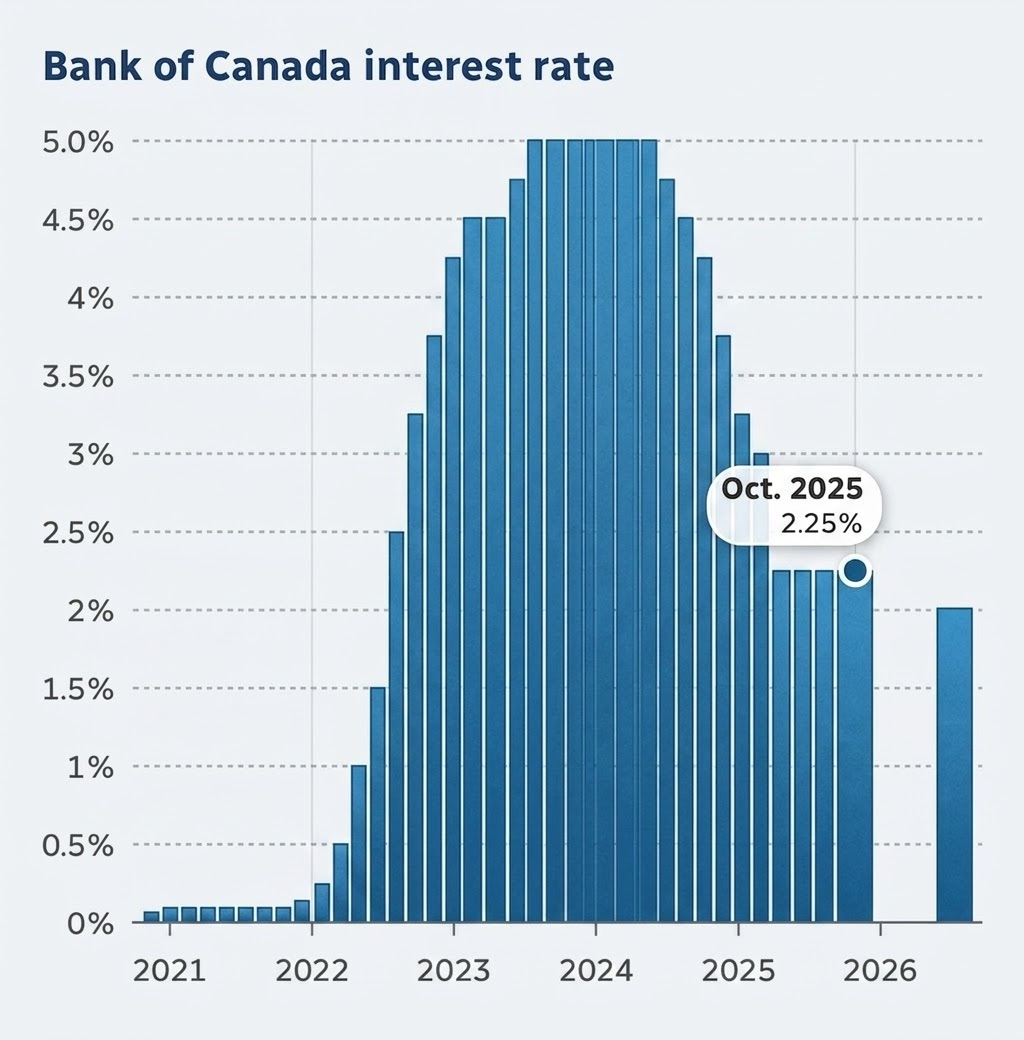
The Bank of Canada kept its policy interest rate at 2.25% on July 15, marking another decision without a change. The Bank sees signs that Canada’s economy has started growing again after a weak start to 2026, while inflation should gradually move lower if energy prices cooperate.
That sounds encouraging. Household finances tell a more complicated story.
Recent Canadian consumer surveys show people continue to cut discretionary spending, worry about debt and devote substantial portions of their paycheques to bills before the money even reaches their accounts.
For households, the practical response isn’t trying to guess the exact date of the next Bank of Canada move. It’s using this period to strengthen the parts of a budget that Canadians can actually control: high-interest debt, credit history, emergency savings and cash earning little or no interest.
What matters now:
The Bank of Canada has kept its policy rate at 2.25%, but borrowing costs and everyday expenses still pressure household budgets. Instead of betting on the next rate decision, Canadians can use this period to reduce expensive debt, protect their credit and make idle savings work harder.
Why Did the Bank of Canada Keep Its Rate at 2.25%?
The Bank of Canada faces two competing forces.
Canada’s economy started 2026 weaker than the Bank expected. Economic activity was roughly flat during the first quarter, and housing activity declined amid affordability challenges and economic uncertainty.
Conditions improved as the second quarter progressed.
The Bank estimated annualized second-quarter GDP growth at approximately 2.5%. Consumer spending remained resilient, exports started growing again and business investment showed signs of improvement.
That recovery gave policymakers less reason to cut rates immediately.
Inflation created pressure in the opposite direction. Canada’s CPI inflation rate reached 3.2% in May, largely because gasoline prices increased following turmoil in the Middle East.
However, inflation excluding gasoline remained much closer to the Bank’s 2% target, and core inflation measures also hovered around 2%.
That combination — improving growth but temporarily elevated headline inflation — helps explain why the Bank chose to wait rather than move rates in either direction.
Where Could Canadian Inflation Go Next?
The Bank expects inflation to ease to approximately 2.5% during the second half of 2026 and return to around its 2% target in early 2027.
But that forecast comes with an important condition.
Oil prices need to behave roughly as the Bank expects.
Continued conflict in the Middle East could push global energy prices higher again. Businesses could eventually pass persistent transportation and energy costs into the prices of other goods and services.
Governor Tiff Macklem has made clear that the Bank does not want temporary energy inflation to turn into persistent, broad-based inflation.
The Bank also continues to watch Canada’s trade relationship with the United States. Tariffs and uncertainty have already affected exports, investment and parts of the Canadian economy.
For households, this means nobody should treat a future rate cut — or rate increase — as guaranteed.
Canadians Are Already Pulling Back on Spending
The macroeconomic numbers can look surprisingly different from what people experience at the grocery store or when a credit-card statement arrives.
A July 2026 MNP Consumer Debt Index, based on an Ipsos survey of 2,000 Canadian adults, found that 61% said at least half of their income was already committed to bills, debt payments and regular expenses before it arrived.
Nearly three in ten — 28% — said their income already wasn’t enough to cover their bills and debt payments.
The pressure has started changing lifestyles.
The same research found that 57% were cutting back on travel and experiences. More than half were reducing dining and social activities, while 48% reported cutting spending on restaurants, patios, takeout or coffee shops.
Another 9% said they were turning to credit or borrowed money to maintain plans and activities.
A separate 2026 TD survey showed the same direction: 35% of Canadians planned to spend less during the summer, while many households redirected money toward necessities such as groceries, fuel and housing.
This doesn’t mean every Canadian household faces financial distress. It does show why an unchanged central-bank rate can feel very different depending on whether someone has savings, a large mortgage, a line of credit or revolving credit-card debt.
Why a 2.25% Bank Rate Doesn’t Mean Your Credit Card Charges 2.25%
This distinction causes plenty of confusion.
The Bank of Canada’s 2.25% policy rate is not the rate consumers automatically receive on mortgages, personal loans or credit cards.
The policy rate influences short-term borrowing conditions throughout Canada’s financial system. Banks and other lenders then price consumer products according to additional factors, including the prime rate, funding costs, product type and borrower risk.
That’s why someone carrying a high-interest credit-card balance can still pay a much higher annual percentage rate even when the Bank of Canada holds its policy rate at 2.25%.
For a household with expensive revolving debt, waiting months for a possible central-bank move may save far less money than reducing the balance now.
Protect Your Credit Score While Money Is Tight
A squeezed budget can create another problem: missed payments.
Payment history plays an important role in Canadian credit scoring. When money gets tight, protecting on-time payments can therefore matter more than chasing complicated “credit score hacks.”
A practical system starts with knowing every payment date.
For example, someone with a credit card, phone bill and line of credit might keep enough money in a dedicated bills account before spending what remains. Setting automatic payments for at least required minimums can provide another safeguard against an accidental missed due date.
That doesn’t mean paying only the minimum is a good long-term debt strategy. Minimum payments can keep high-interest balances around for years. The automation simply acts as a backup against forgetting a payment.
Then direct additional money toward reducing expensive debt whenever the budget allows.
Also check your credit reports periodically for accounts or information you don’t recognize. A good credit-management routine should focus on accuracy and consistent payments rather than obsessing over small short-term score movements.
A High-Interest Savings Account Can Make Idle Cash Work Harder
Higher interest rates aren’t entirely bad news for savers.
A High-Interest Savings Account (HISA) can pay interest on cash that might otherwise sit in a low-interest everyday account.
This can make a HISA useful for money that needs to remain accessible — an emergency fund, upcoming property-tax payment, short-term travel fund or cash reserved for an irregular bill.
But don’t choose an account based only on the largest number in an advertisement.
Some institutions offer temporary promotional rates that fall substantially after several months. Others may impose transaction restrictions, fees or conditions.
Compare the regular rate, promotional period, fees, withdrawal rules and eligibility requirements before moving money.
Also check deposit protection.
The Canada Deposit Insurance Corporation (CDIC) says eligible deposits at member institutions receive automatic insurance of up to $100,000 per insured category, per member institution, including principal and interest.
Eligible HISA deposits can qualify for CDIC protection when consumers hold them at a CDIC member institution and meet the applicable requirements.
HISA or Credit-Card Debt: Where Should Extra Cash Go?
This is where the numbers become more useful than generic advice.
Suppose someone has $1,000 available and carries a credit-card balance charging a much higher interest rate than their savings account pays.
Putting every spare dollar into a HISA while continuing to carry expensive revolving debt may leave that person worse off mathematically.
But draining every dollar of emergency savings can create a different problem. A broken appliance, car repair or unexpected bill could go straight back onto the credit card.
A more practical approach for many households involves maintaining an appropriate emergency cushion while directing additional available cash toward high-cost debt.
The right balance depends on income stability, debt rates, necessary expenses and how much emergency cash the household already has.
Don’t Wait for the Next Rate Cut to Fix the Budget
It’s tempting to build a financial plan around a prediction: “I’ll wait until the Bank of Canada cuts rates.”
That creates a problem because forecasts change.
The Bank of Canada’s second-quarter Market Participants Survey showed a median forecast of 2.25% for the September, October and December 2026 policy decisions. But forecasts aren’t promises, and unexpected inflation, oil prices, trade developments or economic weakness could change the path.
A household budget works better when it can survive more than one interest-rate scenario.
Someone renewing a mortgage, for example, can test the monthly payment at several possible rates rather than assuming the lowest available forecast will arrive at exactly the right time.
Likewise, someone carrying a variable-rate loan can calculate how another increase would affect monthly cash flow.
That small stress test turns an unpredictable economic headline into a number you can actually plan around.
5-Step Money Check for Canadians While Rates Stay at 2.25%
1 — Check what you’re actually paying in interest
List each credit card, line of credit and loan with its current balance, interest rate and minimum payment. Don’t use the Bank of Canada’s 2.25% rate as a substitute for your actual borrowing rate.
→ Bank of Canada: Policy Interest Rate
2 — Protect every payment due date
Use calendar reminders or automatic payments to reduce the chance of missing a bill. If possible, pay credit-card balances in full rather than carrying expensive revolving debt.
3 — Review the last 30 days of discretionary spending
Look at actual transactions rather than estimating. Dining, subscriptions, delivery fees and impulse purchases become much easier to evaluate when you can see the total dollar amount.
4 — Compare where your emergency savings sit
If short-term cash earns almost nothing, compare HISA options. Check the regular interest rate, promotional conditions, fees and access rules — not just the advertised headline rate.
→ CDIC: Check Deposit Insurance Coverage
5 — Stress-test your monthly budget
Calculate whether your household could handle a higher mortgage, loan or essential-expense payment. If the answer is no, identifying the gap now gives you more options than discovering it after costs rise.
What Should Canadians Watch Next?
The Bank of Canada’s next decisions will depend heavily on whether economic growth continues and inflation moves back toward target.
Oil prices remain one of the biggest uncertainties. Canada’s trade relationship with the United States adds another.
If inflation proves more persistent than expected, policymakers could keep rates elevated or respond if necessary. If economic growth weakens substantially and inflationary pressure fades, the calculation could move in the other direction.
For households, trying to predict every move isn’t the most useful strategy.
Three numbers matter much more personally: the interest rate you’re actually paying, the amount of expensive debt you’re carrying and the amount of liquid savings available when something goes wrong.
The Bank of Canada controls its policy rate. Canadians can’t control the next oil-price shock, trade dispute or monetary-policy decision.
They can control what happens to the next paycheque.
Bottom line: Canada’s 2.25% policy rate may stay unchanged for now, but household financial pressure hasn’t disappeared. Paying attention to expensive debt, payment history, emergency savings and the interest earned on cash can matter more to a family’s finances than correctly guessing the date of the next Bank of Canada move.
This article provides general information only and does not constitute financial or investment advice. Individual financial circumstances vary — consider speaking with a licensed financial advisor before making major money decisions.
Sources & Further Reading
- Bank of Canada — July 15, 2026 Interest Rate Decision
- Bank of Canada — Monetary Policy Report, July 2026
- Bank of Canada — Market Participants Survey, Q2 2026
- Ipsos — Canadians Trapped in Pre-Spent Paycheque Cycle
- Canada Deposit Insurance Corporation — What’s Covered
- CBC News — Bank of Canada Holds Key Interest Rate at 2.25%